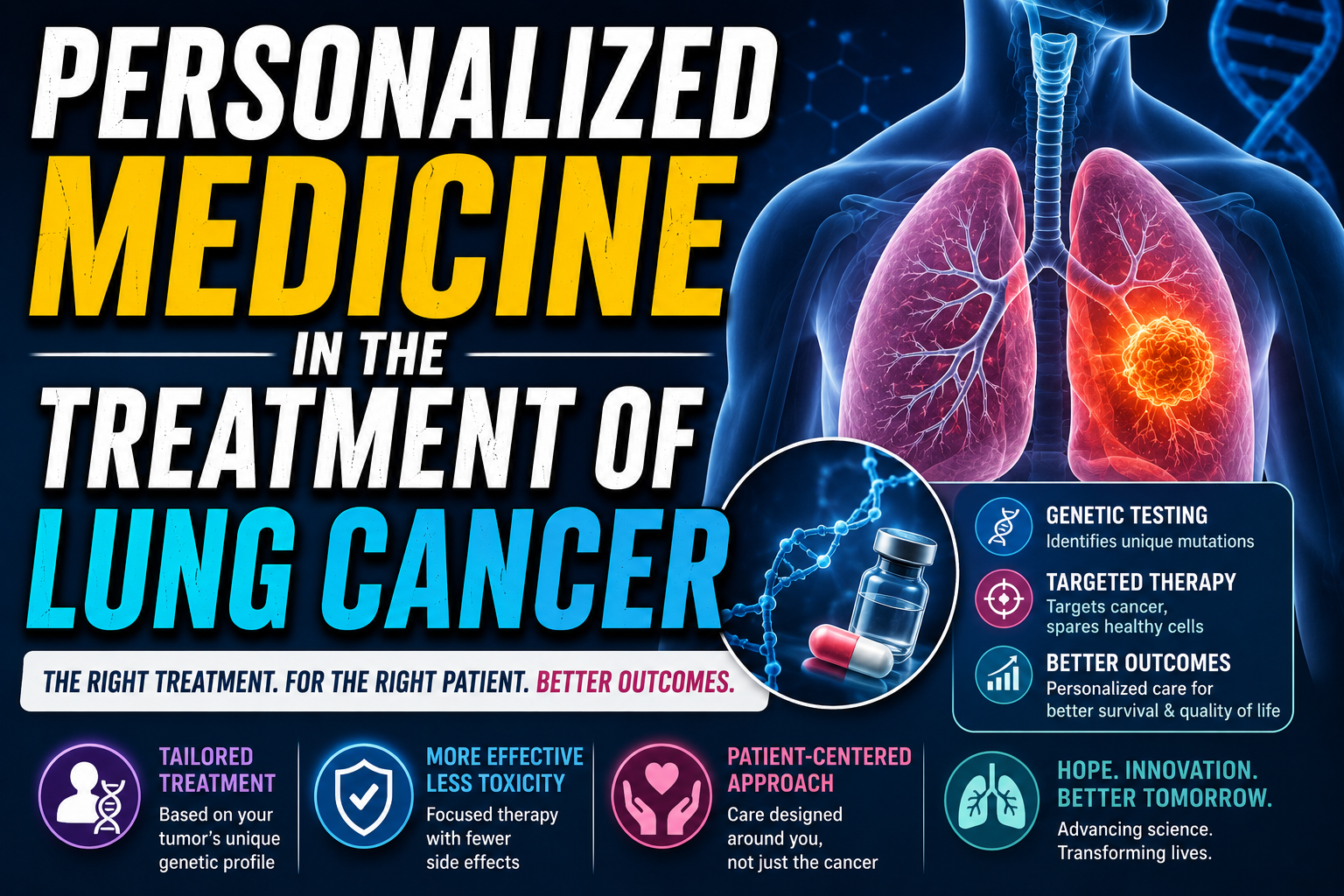
Lung cancer has the highest mortality rate of all cancers and is one of the leading cause of death amongst men suffering from cancers in India. Personalized medicine is defined by the National Cancer Institute as a form of medicine that uses information about a person’s genes and or proteins to prevent, diagnose, and treat disease. Therefore, personalized therapy in lung cancer takes into consideration specific characteristics of the tumor to prescribe the best treatment plan. In the last decade, there has been a major change from the empirical treatment in lung cancer with chemotherapy, where one drug fits all, to a biomarker-based targeted therapy.
There are limited data on personalized therapy specific to stage 1 to stage 3 lung cancer where the mainstay of treatment is surgery, radiotherapy and platinum based chemotherapy doublet. For stage IV cancer the paradigm is now shifting from standard chemotherapy to personalized therapy. Multiple mutations occur in NSCLC, and the spectrum of mutations is very different between smokers and non- smokers, and between squamous-cell carcinoma (SCC) and adenocarcinoma. Both systemic chemotherapies and molecular targeted therapies can take the personalized approach.
PERSONALIZED CHEMOTHERAPY:
Lung cancer comprises different histologic subtypes, including small cell carcinoma and non small cell carcinoma (NSCLC). Non small cell carcinoma has different histopathology subtypes such as adenocarcinoma, squamous cell carcinoma and large cell carcinoma. Squamous cell and nonsquamous cell carcinoma may respond to chemotherapy differently. Pemetrexed is a novel multi-targeted antimetabolite that specifically inhibits the enzymes involved in the folate pathway and DNA synthesis. Recent evidence has emerged that pemetrexed is more effective in patients with nonsquamous cell NSCLC than in those with squamous cell NSCLC. Pharmacogenomics study of a particular patient may guide in the future the treating clinician about the usage of chemotherapy. For example patient with high RRM1 levels will not respond to gemcitabine and those with high ERCC1 levels may respond poorly to cisplatin.
PERSONALIZED TARGETED THERAPY:
Activating mutations in lung cancer in Epidermal Growth factor receptor (EGFR) and the EML4-anaplastic lymphoma kinase (ALK) are important therapeutic targets. There is abundant evidence showing that patients who carry these targets can benefit from the treatment of corresponding inhibitors such as EGFR mutation and ALK arrangements. Currently, there are two types of molecular target therapies approved by the several drug regulatory authorities across the world for the treatment of pulmonary adeno- carcinoma. These are erlotinib/gefitinib, and more recently afatinib, for tumors that carry mutations in the tyrosine kinase domain of EGFR and crizotinib/ ceritinib for tumors with rearrangement of ALK. Both drugs are generically called tyrosine kinase inhibitor (TKI). These drugs have been compared to conventional chemotherapy in stage IV lung cancer patient. When tested in phase three randomized clinical trials tyrosine kinase inhibitors have shown superior response rates and progression free survival but a similar overall survival. This similar overall survival is due to the facts that majority of the patients were allowed to crossover from the chemotherapy arm to targeted therapy arm at the time of progression. However, after an initial response, all patients inevitably progress and several mechanisms including a secondary mutation in exon 20 of the EGFR gene (T790M) or MET or HER2 amplifications are responsible for acquired resistance (AR). Second generation TKIs such as osimertinib and rociletinib are available for patients with T790M mutation.
In the recent years a number of other oncogenic drivers beyond EGFR and ALK inhibition have emerged as novel molecular targets with potential therapeutic implications, including mutations in the genes KRAS, BRAF, HER2, PI3KCA and DDR2, as well as ROS1 and RET rearrangements and MET, HER2 and FGFR1 gene amplifications. Currently we don’t have any drugs to be approved in clinical practice for the above molecular alterations.
Next-generation sequencing (NGS) is a technology that allows for the evaluation of multiple molecular alterations in the same sample using a small amount of tissue. The impact of NGS-based diagnostics is likely to be greater with the increasing availability of novel molecularly targeted agents as well as improved bio informatics . As the cost of next-generation sequencing continues to decrease, this platform is likely to become the diagnostic test of choice for personalized care of patient with advanced NSCLC .
References:
1. Andre LM, Juliana E. Personalized Therapy for Lung Cancer. Chest 146; 6 : 2014.
2. Mok, TSK. Personalized medicine in lung cancer, what we need to know. Nat. Rev Clin Oncol 8, 661–668: 2011.